00
Stablecoins: The Internet’s Financial Base Layer

Stablecoins are not the next Bitcoin; they are the infrastructure layer powering the most durable and scalable utility in Web3. This article unpacks why stablecoins represent one of the clearest signals of real-world demand, and why they may be the strongest contender for venture-scale outcomes in Web3.
From Speculation to Infrastructure
Much of crypto’s early narrative was built around creating a new form of money. Bitcoin was framed as “sound money”, a store of value immune to fiat debasement. But when it comes to day-to-day utility speaking about transactions, remittances and settlements, Bitcoin and other volatile crypto assets fall short. Their performance as a medium of exchange and unit of account is hindered by volatility, lack of price anchoring, and policy uncertainty.
Stablecoins fix this. They provide fiat-denominated stability while inheriting the programmability, speed, and borderless nature of Web3 rails. This makes them the default value layer for the emerging digital economy.
Why Stablecoins Matter
At its core, money exists to facilitate exchange. Stablecoins offer a uniquely internet-native, programmable, and global medium that does this efficiently. They don’t attempt to replace fiat; they amplify it - across borders, time zones, and infrastructure gaps.
Stablecoins didn’t emerge as groundbreaking infrastructure for the digital economy, they were born out of necessity. In 2014, projects like BitUSD on the BitShares blockchain and later Tether (originally “Realcoin”) sought to bring fiat liquidity into the fragmented crypto market. Their primary role was simple, yet powerful: acting as a safe haven from volatility, enabling traders and users to park funds in dollar-pegged tokens without exiting the crypto ecosystem.
Over time, that initial use case - anchoring value for traders - has evolved. Today, stablecoins serve as the critical bridge between traditional finance and Web3, offering 24/7 settlement, low-friction FX, and programmable money rails. Looking ahead, the highest-impact trajectories lie in:
- Cross-border payments, treasuries, and payroll in emerging markets, where volatility and traditional FX costs make stablecoins an operational necessity.
- On-chain real-world (RWA) markets and DeFi, with stablecoins as the foundational medium of value.
- An autonomous, AI-driven economy, where stablecoins act as the preeminent digital currency for machine-to-machine commerce.
By acknowledging their origin and mapping that lineage to these forward-looking, high-impact scenarios, we underscore stablecoins’ true value: not as a stopgap in crypto, but as the backbone of internet-age money.
How Big Are Stablecoins?
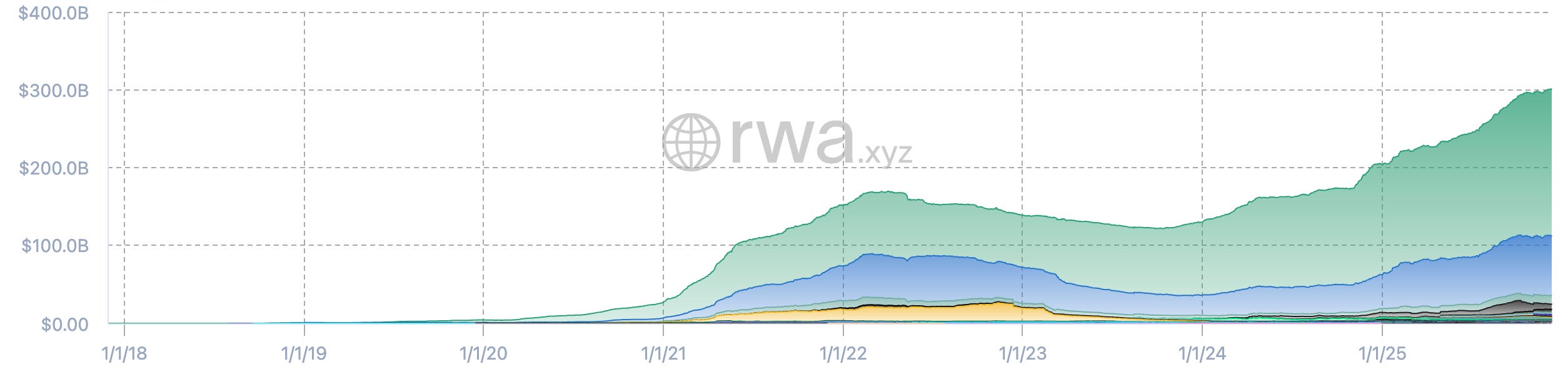
Today, the global stablecoin market stands at ~$300 billion1 in circulating supply.
Stablecoins processed $50 trillion in transaction volume over the last 12 months, up from $27.6 trillion in 20242.
This growth has been driven largely by crypto-native use cases (DeFi, trading, custody). But the next wave is coming from real-world adoption: cross-border payments, B2B settlements, AI-native commerce, and sovereign financial rails.
This shift hasn’t gone unnoticed. Incumbents are now actively building around stablecoin infrastructure.
Stripe made three acquisitions in 2025: Bridge, a stablecoin orchestration platform, Privy, a wallet infrastructure provider serving over 75 million wallets, and the team behind Valora, a mobile-first crypto wallet. These moves enable Stripe to launch stablecoin financial accounts in 100+ countries, allowing businesses to hold, send, and receive stablecoins alongside traditional rails like ACH and SEPA.
PayPal’s PYUSD is live across Ethereum, Solana, and Stellar, integrated into PayPal and Venmo, and offers yield on idle balances, bringing stablecoin functionality into everyday consumer finance.
Visa partnered with Bridge to launch stablecoin-linked cards in Latin America, enabling stablecoin spending with fiat conversion at the merchant layer.
Circle’s IPO was met with strong institutional demand, underscoring stablecoin’s arrival as a regulated investable asset class.
This wave of adoption is further reinforced by regulatory momentum. The U.S. recently passed the Genius Act, a landmark bipartisan bill establishing the first federal framework for payment stablecoins. It mandates full-reserve backing, public disclosures, and consumer protections, bringing regulatory clarity without stifling innovation.
But beyond compliance, the bill reflects a broader strategic calculus: stablecoins backed by U.S. Treasuries can serve as a powerful tool of dollar export, extending USD demand globally at a time when the dollar’s reserve currency status faces renewed geopolitical challenges.
As stablecoins mature into programmable, globally interoperable financial instruments, the U.S. is beginning to recognize them not just as a crypto innovation, but as a lever of economic statecraft.
The $16 Trillion Opportunity
To contextualize the scale of the stablecoin opportunity: global M2 money supply is estimated at ~$96 trillion3. If stablecoins ultimately capture a digitizable portion of global money supply comparable to e-commerce’s share of total commerce (~17%)4, this implies a ~$16 trillion market - a 54× expansion from today’s $300 billion supply.
Even partial adoption positions stablecoins as one of the few multi-trillion-dollar opportunities in Web3 over the next decade.
Our Skin in the Game
We are actively investing behind our conviction in stablecoins as a foundational layer of the digital economy. We back founders building critical infrastructure across the payment and settlement stack, with use cases that extend well beyond crypto-native contexts.
Nilos is building enterprise-grade payment infrastructure that leverages stablecoins to simplify global money movement for businesses. By enabling instant cross-border settlement, multi-currency management, and treasury automation through a unified API, Nilos reduces dependence on traditional correspondent banking networks. It offers a compelling alternative for companies operating in fragmented or high-cost financial environments.
Kulipa focuses on bridging on-chain assets with real-world spending. Its platform enables wallets and fintechs to issue Visa-compatible cards, allowing users to spend stablecoins seamlessly at the point of sale. Real-time conversion from stablecoins to fiat ensures smooth merchant acceptance, while preserving a crypto-native backend. This infrastructure plays an important role in extending stablecoin utility into everyday payments.
YouSend is building a stablecoin-powered payments platform, designed to streamline cross-border money movement. The platform enables near-instant, low-cost transfers to local bank accounts or e-money wallets, offering a more efficient alternative to traditional remittance channels. In doing so, it brings the benefits of stablecoins to real-world financial inclusion use cases.
Flyra is building a banking platform for migrants that connects how money is earned, moved, and spent across borders. Using stablecoin rails, funds flow instantly from payroll or gig apps into users’ wallets and cards, where they can be spent, used for bills, or saved directly, replacing slow cross-border flows.
Spiko is pioneering a nuanced variant of the stablecoin model by issuing tokenized money-market funds backed entirely by U.S. and Eurozone Treasury Bills and fully regulated under EU UCITS frameworks. These tokenized shares (e.g., USTBL, EUTBL) function as digital cash equivalents, compatible with EVM-based wallets and blockchain applications.
Collectively, these companies are contributing to the evolution of stablecoins from a liquidity tool within crypto markets to a robust, programmable value layer for global commerce. But this is only the beginning. As stablecoins continue to evolve into a foundational layer for global payments, capital markets, and machine-driven economies, we see further opportunity to invest across the broader ecosystem. In the sections that follow, we outline the key growth drivers and investment themes where we believe the next wave of category-defining companies will emerge, and where we are actively looking to partner with ambitious teams building at the frontier.
Key Growth Drivers & Investment Themes
As stablecoins become programmable financial primitives, we see six core areas where they are unlocking real economic value:
1. Emerging Markets & Cross-Border Transfers
- Businesses replacing banks and TradFi rails with stablecoin-based solutions to pay suppliers and employees across and within borders, avoid FX costs and settlement delays, manage treasury, and optimize working capital.
- Individuals using stablecoins to hedge against local inflation, access USD-based savings, and participate in global financial services otherwise unavailable to them.
- Expats turning to stablecoin-based remittance channels to unlock exotic corridors and move money in and out of countries more efficiently and affordably.
2. DeFi & Tokenized Markets
- With real-world assets moving (RWA) on-chain, stablecoins are becoming the necessary base layer for expressing fiat-denominated value, enabling credit, settlement, and market-making in tokenized environments.
- We expect stablecoin-powered DeFi to scale further as corporate treasuries and TradFi participants begin engaging through permissioned pools and regulated protocols.
3. Stablecoin Issuance
- Interest-bearing stablecoins (e.g., Ethena’s sUSDe, USDM) bridging on-chain capital to real-world yield sources.
- Programmable stablecoins embedding compliance, tax logic, or purpose-limited flows at the protocol level.
- Regulated, fully-reserved stablecoins issued by licensed banks and fintechs emerging as credible alternatives to commercial bank deposits.
- Region-specific stablecoins (e.g., Euro, Peso, Naira) gaining interest, particularly in jurisdictions where unfettered USD inflows threaten monetary sovereignty and capital controls.
4. Middleware & Tooling
- Infrastructure layers for stablecoin issuance, custody, compliance, accounting, and reporting are critical for enterprise and institutional adoption.
- Cross-chain protocols enabling stablecoin mobility across Ethereum, Solana, Cosmos, and Layer 2 ecosystems.
- Data infrastructure, from oracles to behavioral analytics, unlocking visibility into stablecoin usage, velocity, and risk exposure.
5. On-Chain Treasuries & Corporate Finance
- Startups, DAOs, and crypto-native firms increasingly hold and manage stablecoins for treasury, payroll, and working capital, especially in high-volatility jurisdictions or sectors.
- The opportunity lies in building products for yield optimization (e.g., tokenized T-Bills), programmatic disbursement, cap table management, and compliance reporting, all natively integrated with stablecoin rails.
- This area will be especially critical as more companies transition to on-chain operations and demand tools that match the sophistication of traditional finance.
6. AI & Stablecoins
- As agents and protocols become autonomous, stablecoins are emerging as the optimal medium of exchange, offering price stability, low latency, and interoperability.
- Use cases include machine-to-machine payments, AI-native marketplaces, and autonomous financial operations executed by smart contracts or agents.
Final Thoughts
Stablecoins may no longer be the quiet corner of crypto. Their growth today is driven by genuine adoption. They embody what the Web3 ecosystem needs: clear utility, global scale, and real-world demand. They’re not here to replace money, but to make it work better, across every layer of the economy.
For founders building in this space, or adjacent verticals like tokenized finance, AI agents, or on-chain payments, this is an inflection point.
If you’re building or investing in the stablecoin stack, I’d love to exchange ideas or explore collaboration. Let’s push the stablecoin utility layer forward; together with the builders, operators, and investors shaping the next financial era.
1 https://app.rwa.xyz/stablecoins
2 https://visaonchainanalytics.com/transactions
3 https://streetstats.finance/liquidity/money
4 https://www.statista.com/statistics/534123/e-commerce-share-of-retail-sales-worldwide/
Disclaimer
To avoid any misinterpretation, nothing in this blog should be considered as an offer to sell or a solicitation of interest to purchase any securities advised by Blockwall, its affiliates or its representatives. Under no circumstances should anything herein be interpreted as fund marketing materials for prospective investors considering an investment in any Blockwall fund. None of the data and information constitutes general or personalized investment advice and only represents the personal opinion of the author. The author and/or Blockwall may directly or indirectly be exposed to the mentioned assets/investments. For further information please view the full Disclaimer by clicking the button below.
This work is licensed under the Creative Commons Attribution – No Derivatives 4.0 International License. CC BY-ND 4.0 Legal Code | Creative Commons