00
The Hidden Power of Prediction Markets: Beyond Gambling, Into Data Mining


Prediction markets are often dismissed as gambling platforms. That couldn’t be further from the truth. Gambling relies on luck: no amount of research can change the odds of a dice roll or a roulette spin. Prediction markets, on the other hand, operate like stock markets. Prices aren’t set by a bookmaker; they emerge from collective intelligence. Participants buy and sell based on their own research, information, and understanding of the world.
The difference lies in agency. In prediction markets, your edge is knowledge. The more you know, the higher your chance of being right.
The Real Value: Data Mining With Financial Incentives
Speculation exists, but the deeper purpose goes beyond just making money. It’s the incentive mechanism that uncovers truth. Every trade is a data point, a reflection of what traders believe will happen and how confident they are. Platforms like Polymarket generate extraordinary data streams from this collective information flow, valuable enough to be seen as a data company more than a trading venue.
The market itself becomes a real-time engine of insight: price movements quantify public expectations before events unfold. Wrong forecasts cost money, right ones pay off. An elegant demonstration of the Efficient Market Hypothesis. Financial incentives push accuracy, compress deceit, and amplify genuine belief.
That’s why even the CIA explored these systems two decades ago, as documented in “Prediction Markets: Enhancing Intelligence Analysis.“ They understood that data tied to financial risk reveals clearer truth than surveys or polls ever could.
Proof of Incentive: A New Kind of Consensus
Think of prediction markets as human-operated blockchains. Bitcoin uses electricity to mine new blocks; prediction markets use humans to mine data. Electricity secures Bitcoin’s consensus; financial incentives secure prediction markets’ consensus.
This mechanism, call it Proof of Incentive, turns greed into a data engine. Just as Proof of Work transforms computational effort into scarcity, prediction markets transform human curiosity into measurable belief.
The result? Financialized opinions: infinitely sharper, faster, and more accurate than polls or expert panels.
Data Becomes Commodity
Data is already the most valuable resource of the 21st century; prediction markets simply financialize it more transparently. Once truth discovery is incentivized with money, accuracy skyrockets.
As proof:
- Orange juice futures have historically outperformed the U.S. National Weather Service in forecasting Florida freezes. (Academic studies, 1980s-2000s)
Incentives, not luck, drive the forecasting edge. Options trading works similarly but remains gated by regulation, collateral, and insider access. Prediction markets democratize that intelligence capture and expand it to thousands of potential outcomes, not just a few regulated assets.
Rediscovering Product-Market Fit
At Blockwall, we think the product-market fit for prediction markets goes far beyond speculation or even political forecasting. The real opportunity is as insurance for uncertainty. Instead of betting on elections, prediction markets become the infrastructure where institutions hedge any risk: farmers hedging crop failure through weather markets, corporations hedging currency exposure on forex outcomes, communities hedging earthquake risk through property damage markets.
Any measurable event becomes tradeable. The distinction between insurance, hedging, and speculation collapses into one unified system. By expressing complex or unconventional risks as tradable outcomes, prediction markets compete not only with derivatives and options but also with traditional insurance and corporate forecasting.
Imagine hedging rainfall risk through tokenized contracts verified by weather data, or covering rent fluctuations in on-chain real estate portfolios with dynamically adjusted prediction markets. These contracts turn almost any measurable uncertainty into a quantifiable, tradeable event.
Let’s take a Californian apple farmer worried about EU tariffs. No classic hedge exists for this risk. But the farmer can buy a contract that pays out if the EU actually imposes new tariffs. The market odds become embedded in news cycles too: when a crisis emerges or a claim is made, odds appear alongside coverage as a reality check, showing what money-backed consensus actually believes versus what talking heads assert.
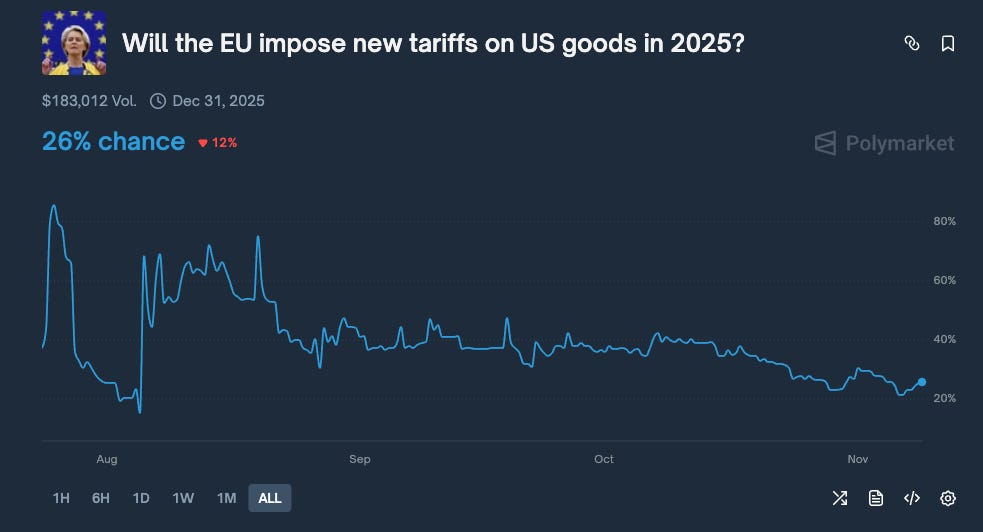
Polymarket contract on whether the EU will impose new tariffs on US goods in 2025 shows real-time market odds which traders use to hedge or speculate on trade policy risk.
The Billion-Dollar Opportunity
The first killer applications won’t come from crypto-native traders. They’ll emerge in old-world industries desperate for better data feedback loops:
- Traditional Finance (highest TAM): Quarterly earnings outcomes, macro indicators (inflation, tariffs), sector catalysts.
- Agriculture: Forecasting weather, yields, commodity prices.
- Insurance: Hedging localized risks (hurricane paths, wildfire spread).
- Logistics: Pricing delivery delays, fuel volatility, supply disruptions.
Prediction markets supercharge decision loops in these sectors by converting uncertainty into priced information. When greed is gamified into truth discovery, efficiency follows.
From DARPA to DeFi
In the early 2000s, DARPA explored a government-backed prediction system called FutureMAP (Futures Markets Applied to Prediction), which included the Policy Analysis Market (PAM). It was shelved after political backlash in 2003, but the idea didn’t die. It quietly shifted toward private-sector development.
The CIA funded prediction market research starting in 2001 because they recognized that financial incentives create powerful signals of truth. Markets where money is at stake compress information more efficiently than expert panels or consensus estimates.
It’s wise not to fade prediction markets now. The technology has re-emerged on blockchains where censorship resistance, composability, and global liquidity make it unstoppable.
The Missing Piece: Who Monetizes the Data?
Here’s what’s changing: Until recently, prediction market data has been treated like a public good, free APIs for anyone to access. Polymarket is pioneering the shift toward enterprise data monetization.
Their October 2025 partnership with ICE (owner of the NYSE) makes ICE the global distributor of Polymarket’s event-driven data to institutional clients. This is the Bloomberg Terminal play: real-time market probability data becomes a licensed product for hedge funds, corporations, and financial institutions worldwide.
Bloomberg already integrated Polymarket election odds into Terminal in 2024, showing that institutional demand for this data exists. But ICE’s involvement signals something bigger: Wall Street is building infrastructure to make prediction market data a core asset class feed, the same way it distributes stock prices, options flows, and futures data today.
Polymarket is now targeting a $12-15 billion billion valuation while charging zero trading fees. Why? Investors aren’t buying a betting app; they’re buying data infrastructure. The model flipped from taking trading fees to monetizing the data itself.
Why This Matters
The shift from speculation to infrastructure reveals the true thesis: prediction markets aren’t about gambling. They’re about converting uncertainty into information. When Wall Street captures that data stream, prediction markets stop being a crypto novelty and become a foundational layer of capital markets.
The billions flowing into Polymarket and similar platforms don’t reflect trader enthusiasm. They reflect institutions betting that real-time, incentivized probability data will become a foundational commodity in finance—potentially as essential to modern markets as price feeds or economic indicators. That’s the hidden power at work.
Final Thoughts
Looking ahead to 2026, we expect prediction markets to evolve beyond their current narrow focus. While binary platforms like Polymarket and Kalshi serve as strong starting points, the real opportunity lies in their progression toward practical tools for investors and institutions to express risk, such as hedging temperature variance or tariffs rather than trading on elections and memes.
We anticipate that prediction markets will mature into a new type of financial market, enabling participants to express and hedge risks in ways that were not possible before blockchain and positioning them as core market infrastructure. Arrow Debreu securities in the form of conditional markets are now re-emerging onchain, bringing back ideas that previously failed due to limited infrastructure. We believe many of these concepts will gain traction in 2026.
This development aligns with the broader maturity thesis around dispersion, highlighting the need for tools, applications, and protocols that let investors form increasingly precise views on the world. As more markets are built onchain and connected to DeFi, we see strong potential for a new class of financial products that integrate user positions and market data from these systems, making prediction markets the natural hedging layer for tokenized assets.
In 2026, we will be watching closely for founders building solutions that make prediction markets more expressive, data rich, and practical for real-world use cases.
If you’re working on these challenges or know projects pushing this frontier, I would love to exchange ideas or hear your perspective
Disclaimer
To avoid any misinterpretation, nothing in this blog should be considered as an offer to sell or a solicitation of interest to purchase any securities advised by Blockwall, its affiliates or its representatives. Under no circumstances should anything herein be interpreted as fund marketing materials for prospective investors considering an investment in any Blockwall fund. None of the data and information constitutes general or personalized investment advice and only represents the personal opinion of the author. The author and/or Blockwall may directly or indirectly be exposed to the mentioned assets/investments. For further information please view the full Disclaimer by clicking the button below.
This work is licensed under the Creative Commons Attribution – No Derivatives 4.0 International License. CC BY-ND 4.0 Legal Code | Creative Commons